Anthropic S-1 filing – an analyst's breakdown
Hypergrowth that has already turned an operating profit, a compute bill that dwarfs revenue, and a share class with no say.
Updated 4 Nov 2026
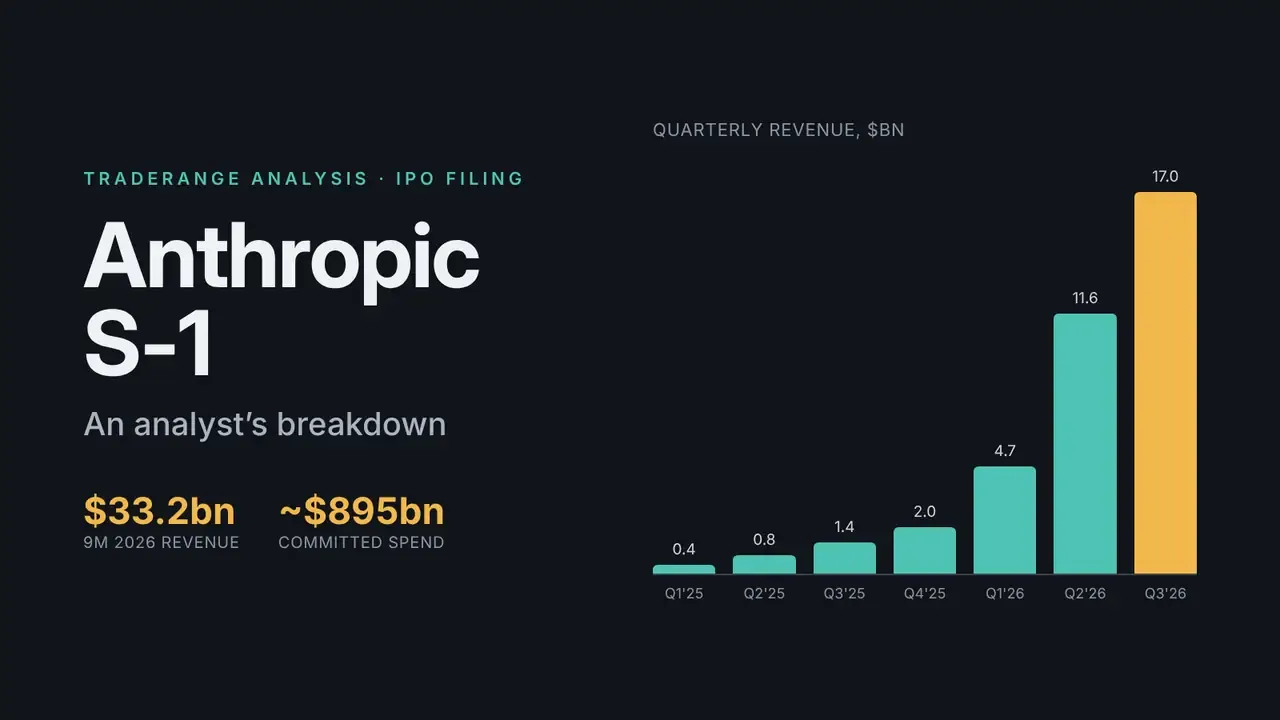
Anthropic is not a software company that happens to buy a lot of compute. Having gone through the S-1 filed on October 26, 2026 and the third-quarter figures from the amended filing, we think it is best read as three things stacked on top of each other: a revenue engine growing faster than anything that has come to market, an operating business that posted its first operating profit in Q2 2026, and roughly $895.4bn of committed compute and infrastructure spend that will decide whether the first two are enough. Public shareholders get the economics of all three and control over none of them.
Key takeaways
- Revenues rose from $41 million in 2023 to $4.59 billion in 2025, and to $33.24 billion in the first nine months of 2026.
- The core business reported an operating profit of $974 million in the second quarter of 2026. The $80.7 billion first-half net loss is overwhelmingly non-cash fair-value charges on convertible notes.
- Sequential growth slowed to about 47% in the third quarter of 2026, after 144% in the second quarter, while our estimate of compute costs rose about 77%.
- Committed compute and infrastructure spend is about $895.4 billion, roughly 25 times trailing-twelve-month revenue, much of it with suppliers that are also investors and distributors.
- Seven co-founders control 50.1% of the votes through one Class F share, and a trust elects the board majority. Class A buyers get the economics, not control.
Anthropic: Quarterly revenue versus costs for computing resources and infrastructure
$bn. Q1 2025 to Q2 2026 from the S-1 quarterly table. Q3 2026 revenue is derived from the amended S-1 nine-month total; Q3 2026 compute is our estimate from the amended filing's nine-month growth figure.
1. Engine of growth
Revenue was $41 million in 2023, $386 million in 2024 and $4.59 billion in 2025. In the first half of 2026 it reached $16.3 billion against $1.2 billion a year earlier, an increase of about 1,300%. The amended S-1 puts nine-month revenue at $33.24 billion, which implies roughly $16.95 billion for the third quarter alone, about 1,127% higher than Q3 2025.
The customer data explains where that comes from. At September 30, 2026 Anthropic had more than 11,900 customers generating $100,000 or more of trailing-twelve-month revenue, up from more than 950 a year earlier. More than 1,900 spend over $1 million and about 250 spend over $10 million. Net revenue retention was about 900%, meaning the same customers spent roughly nine times as much as they did a year before. With around 5,300 employees, trailing revenue per head is over $6.6 million, against $1.4 million a year earlier.
⚠
Growth is uneven, and slowing on a much bigger base
Sequential revenue growth was about 48% in Q4 2025, 132% in Q1 2026, 144% in Q2 and about 47% in Q3. The S-1 ties the jumps to model releases (versions launched in the prior six months made up over 80% of Q3 revenue) and flags summer and winter seasonality. It also warns plainly that the growth rate will decline, possibly faster than the company expects, and that it has struggled to forecast its own revenue.
The concentration of customers is moderate, but real. The top five customers were about 25% of nine-month revenue, though none exceeded 10%, and 48% of first-half 2026 revenue was billed through cloud marketplaces run by the same hyperscalers that supply Anthropic's compute and own part of the company.
2. The margin story: real profits, noisy accounts
Underneath the headline losses, the operating business has turned. The operating loss narrowed from $8.06 billion in 2025 to $693 million in the first half of 2026, and Q2 2026 produced operating income of $974 million, an 8% margin. On the company's adjusted basis, which strips out stock-based compensation, the Q2 margin was 19%. The driver is simple: compute and infrastructure fell from 251% of revenue in Q1 2025 to 48% in Q2 2026.
So why an $80.7 billion net loss for the half? Anthropic marks its convertible notes to fair value. Those notes are $6.2 billion of non-interest-bearing paper held by Amazon, and every jump in Anthropic's valuation revalued them upward, producing $72.4 billion of non-cash charges in the first half alone. On the company's adjusted measure, first-half net income was $2.67 billion. The charges largely stop once the notes convert at the IPO, although any portion above Amazon's 12% ownership cap rolls over and keeps being marked.
Q3 is where the cost base caught up. The amended S-1 says compute and infrastructure expense rose $14.4 billion, or 329%, over the nine months. Backing out the first half, we estimate Q3 compute at about $9.8 billion, around 58% of revenue against 48% in Q2. Revenue per dollar of compute fell from about $2.08 to $1.72. This is exactly what the filing warns about: compute is contracted 12 to 18 months ahead and expensed as it comes online, before the revenue it is meant to support.
3. The $895 billion question
The most important number in the filing is not revenue. Purchase commitments were $54.6 billion at the end of 2025. By June 30, 2026 the S-1 showed $265.6 billion of minimum purchase commitments plus $321.4 billion of leases signed but not yet started, and roughly $245 billion more was signed or amended after June. The amended S-1 now puts aggregate committed spend at about $895.4 billion, around 25 times trailing-twelve-month revenue of roughly $35.3 billion.
Largest named compute commitments in the S-1
$bn, minimum or maximum committed amounts as disclosed. Broadcom is rent on TPU equipment leases. Excludes an estimated $125 billion to $150 billion of extra TPU compute and over $20 billion of AMD systems that carry no fixed commitment.
Many of these counterparties are also investors and distribution partners. Amazon's notes convert into up to 1.84 billion shares at fixed prices of $2.09 and $5.05. Google, Amazon and Broadcom have committed a further $77 billion of note facilities that can convert into stock, and $AMD has agreed to buy up to $5 billion of shares as its GPUs are delivered. Broadcom's $42 billion facility exists, if needed, solely to finance Anthropic's rent on Broadcom's own leased equipment. In practice, the suppliers are funding their own sales and taking equity in return.
One detail for readers of our SpaceX S-1 breakdown: Anthropic expects to pay SpaceX's AI unit about $3.1 billion a month once capacity is fully delivered in December 2026, up to $120.5 billion into 2029. That is about $9.3 billion a quarter, close to Anthropic's entire estimated Q3 compute bill, and roughly $37 billion a year to SpaceX, against the $3.2 billion of revenue its AI segment reported for all of 2025. It puts a large, named customer behind the AI capex we questioned in that piece, but either side can walk away on 90 days' notice once the initial non-cancellable periods end in early 2027.
ℹ
Cash is not the constraint. Timing is.
At June 30, 2026 Anthropic held $112.4 billion of cash and $19.3 billion of short-term investments, generated $3.9 billion of operating cash flow in the half and has since lifted its revolving credit facility to $15 billion. The risk is not running out of money next year; it is that commitments are fixed while revenue is not, and the original S-1 left the table showing when payments fall due blank.
4. Who is in charge
Anthropic is a Delaware public benefit corporation, so its directors must balance shareholder returns against its stated purpose. A Long-Term Benefit Trust holds the single Class T share and elects a majority of the board. Immediately before the IPO, the seven co-founders' Founder LLC receives one Class F share carrying 50.1% of total voting power, which caps all Class A holders together at 49.9%. The Class F share only goes away if fewer than three founders remain for 90 consecutive days, followed by a 450-day transition. Nasdaq treats the company as controlled.
The public benefit commitments are also dilutive by design: 5% of fully diluted shares already sits in an Anthropic Public Benefit Fund, the board may add up to 2% more each time the share price climbs 50% above the previous milestone, and each co-founder has pledged 80% of their equity to philanthropy.
…not to think of your purchase in purely transactional terms.
5. What the filing still does not tell you
Based on the filings available to us, these questions remain open:
- The price range, share count and offering size are all blank.
- The original S-1 left the contractual-obligations table empty. The amended filing gives the $895.4 billion total, but we have not seen a year-by-year payment schedule.
- The original lock-up schedule lists dates but not how many shares unlock on each.
- There is no guidance on revenue or margins for Q4 2026 or 2027.
- The outcome of the US government dispute. After a February 2026 presidential directive that federal agencies stop using Anthropic's models and a Department of War supply-chain risk designation, a district court largely ruled in Anthropic's favour, while a D.C. Circuit panel denied its separate petition 2-1. Anthropic has asked for a rehearing.
Bottom line
From the S-1, the quality of the business is not in question: revenue up roughly 13x in a year, a first quarterly operating profit in Q2, customers expanding at about 900% net retention and one of the largest cash piles any company has brought to an IPO. What a buyer is really underwriting, though, is a levered bet that demand keeps outrunning a mostly fixed compute bill, signed with counterparties that are also its investors and distributors, in a company whose voting control stays with seven founders and a trust.
Q3 is where that bet visibly tightened. Our view: an exceptional operator, but the shares are unpriceable until the range is set, and the price matters more than usual. At the $1.5 trillion to $2 trillion valuations being discussed in the market, buyers would pay roughly 22x to 29x annualised Q3 revenue for a business whose margins the company itself expects to compress. For the numbers behind each point, see our deep dive.
ℹ
Sources and scope
Based only on Anthropic's S-1 filed on October 26, 2026, the amended S-1 with Q3 figures as reported, and contemporaneous coverage of those filings. Estimates marked as ours are derived arithmetically from those figures. This is analysis, not a recommendation to buy or sell any security.