Anthropic S-1 deep dive: unit economics, the compute bill and who controls the company
The evidence behind our overview: where the profits come from, what the commitments really are, and what Class A buyers actually get.
Updated 4 Nov 2026
In our overview of Anthropic's S-1, we argued that the business is exceptional and that it reached its first operating profit in the second quarter of 2026. The real question for buyers is whether demand keeps outrunning about $895.4 billion of committed compute spend, in a company they cannot control. This deep dive sets out the evidence for that view, in the same order: the revenue engine, unit economics and margins, the accounting behind the headline loss, the commitment stack and how it is financed, liquidity, governance, risks and valuation.
Everything here comes from the S-1 filed on October 26, 2026, the amended S-1 with third-quarter figures as reported, and contemporaneous coverage of those filings. Where we derive a number ourselves, we say so and show the arithmetic.
Key takeaways
- Revenues: $41 million in 2023, $386 million in 2024, $4.59 billion in 2025, and $33.24 billion in the first nine months of 2026.
- Compute fell from 251% of revenue in the first quarter of 2025 to 48% in the second quarter of 2026, delivering an 8% operating margin. We estimate it rose back to about 58% in the third quarter.
- Of the $80.7 billion first-half net loss, $81.1 billion came from non-cash fair-value and other non-operating charges, mostly on $6.2 billion of Amazon notes now carried at $108.6 billion.
- Committed spend grew from about $105 billion at the end of 2025 to about $895.4 billion in the amended S-1, with suppliers offering up to $82 billion of financing that converts into equity.
- Class A holders get at most 49.9% of the vote. Founders hold 50.1% through Class F, and a trust elects the board majority.
- At the $1.5 trillion to $2 trillion valuations discussed, the IPO would price at 50% to 100% above the last private round.
Summary P&L, in billions of dollars. From the S-1 consolidated statements of operations and the non-GAAP reconciliation. Adjusted figures exclude stock-based compensation, non-cash charitable contributions and the Bartz settlement.
| Line ($bn) | FY2023 | FY2024 | FY2025 | H1 2025 | H1 2026 |
|---|---|---|---|---|---|
| Revenue | 0.04 | 0.39 | 4.59 | 1.16 | 16.29 |
| Compute and infrastructure | 0.43 | 2.52 | 7.33 | 2.33 | 8.95 |
| Personnel | 0.10 | 0.45 | 1.84 | 0.54 | 3.15 |
| Sales marketing and partnerships | 0.00 | 0.04 | 0.57 | 0.12 | 3.17 |
| Operating income (loss) | -0.55 | -2.98 | -8.06 | -2.14 | -0.69 |
| Adjusted operating income (loss) | -0.52 | -2.79 | -4.85 | -1.85 | 1.62 |
| Fair-value change on notes/derivatives/SAFEs | -1.05 | -5.43 | -34.31 | -10.94 | -72.39 |
| Net loss | -1.53 | -8.31 | -41.97 | -12.97 | -80.75 |
| Adjusted net income (loss) | -0.46 | -2.68 | -4.45 | -1.74 | 2.67 |
1. The revenue engine
Anthropic sells access to four Claude model classes, Mythos (including Fable), Opus, Sonnet and Haiku, plus applications such as Claude Code and Claude Cowork built on its own platform. Most revenue is pay-for-intelligence: customers pay per token, priced by model. Consumption made up $13.1 billion, or 80%, of first-half 2026 revenue and subscriptions $3.2 billion, or 20%. Customers can contract directly or buy through the AWS, Google Cloud and Azure marketplaces, with Anthropic keeping the direct contract and paying the cloud provider a fee.
Customers generating $100,000 or more of trailing-twelve-month revenue
Approximate counts as disclosed in the S-1 at each date; the September 2026 figure is more than 11,900.
These larger customers drive the business. Revenue from customers above the $100,000 line grew from about $37 million in 2023 to $220 million in 2024 and $3.5 billion in 2025, or 76% of that year's revenue. At September 30, 2026, the remainder of trailing revenue came from roughly 40 million smaller customers. Penetration is still shallow: more than 50% of the Fortune 500 are $100,000-plus customers, yet on average Anthropic accounted for less than 0.1% of their total expenses in the third quarter of 2026, and less than 1% even for its ten largest Fortune 500 customers.
Net revenue retention of about 900% at September 30, 2026 compares one quarter's revenue with the same customers' revenue a year earlier, and excludes fixed-price Claude Pro and Max subscribers. Two disclosures temper it. First, the product cycle is a treadmill: model versions released in the prior six months produced over 80% of third-quarter revenue, and Claude Opus 5.5 cut customers' cost per task by about 40% against Opus 5, so usage has to grow faster than the price per task falls. Second, spend is seasonal: in the two weeks to January 2, 2026 it fell about 20% from the prior two weeks.
Concentration and channel risk
Share of revenue billed through cloud marketplaces
Share of total revenue from sales through CSP marketplaces, per the S-1 risk factors.
The five largest clients accounted for approximately 25% of total revenue in the first nine months of 2026. None of these clients accounted for more than 10% of total revenue. The degree of concentration is decreasing: approximately 79% of revenue in the third quarter came from clients who were not among the five largest clients, which is higher than 64% in the first quarter. Sales channels play an important role as well: cloud service platforms accounted for 48% of revenue in the first half of the year. As of June 30, 2026, they accounted for 58% of total accounts receivable. In the S-1 document, these suppliers are described as investors, clients, distribution partners, and at the same time, competitors.
⚠
Sequential growth by quarter
Q2 2025 +109%, Q3 2025 +76%, Q4 2025 +48%, Q1 2026 +132%, Q2 2026 +144%, Q3 2026 about +47%. Growth re-accelerated after the Q4 2025 slowdown on new model releases, so one soft quarter is not a trend. But the base is now about $17 billion a quarter, and the S-1 expects the growth rate to decline, possibly sharply.
2. Unit economics and margins
Compute is Anthropic's dominant cost, and the whole margin story is the ratio of revenue to compute. Because capacity is contracted 12 to 18 months in advance and expensed as it is delivered, the cost line moves in steps while revenue compounds in between.
Revenue generated per $1 of compute and infrastructure expense
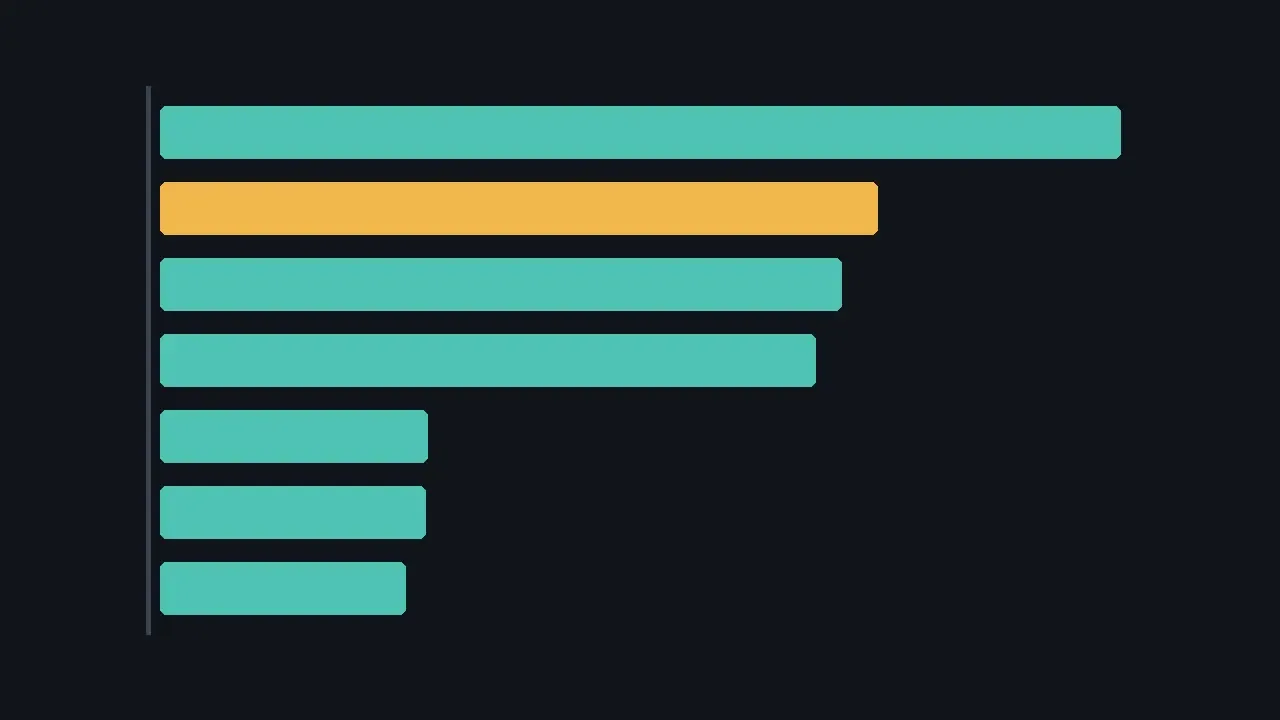
Quarterly revenue divided by compute and infrastructure expense, from the S-1. The third quarter of 2026 uses our estimate of that quarter's compute (about $9.8 billion), derived from the amended S-1.
Revenue per compute dollar rose from $0.40 to $2.08 over five quarters. In the second quarter of 2026, revenue grew 1,368% year on year while compute expense grew 300%. That is what took the operating margin from deeply negative to positive:
Operating margin versus adjusted operating margin
Percent of revenue, quarterly, from the S-1. Adjusted margin excludes stock-based compensation, non-cash charitable contributions and the $1.5 billion Bartz settlement in the third quarter of 2025.
Other costs scaled well too. Personnel fell to 16% of revenue in the second quarter of 2026, and sales, marketing and partnerships ran at 19% of first-half revenue, with the increase driven mainly by fees paid to channel partners and by marketing rather than by a large sales force. Stock-based compensation was $2.2 billion in the half.
The third quarter of 2026 reversed part of that. The amended S-1 reports nine-month compute and infrastructure expense up $14.4 billion, or 329%. Nine-month 2025 compute was $4.38 billion, so nine-month 2026 compute was about $18.8 billion and the third quarter alone about $9.8 billion, roughly 58% of revenue and 77% above the second quarter. Revenue per compute dollar fell to about $1.72. The third quarter also carried a $2.0 billion non-cash donation-matching charge, which the adjusted measures exclude, and a reported net loss of $23.29 billion.
ℹ
The company is telling you margins will be lumpy
The S-1 says operating margin may compress whenever large blocks of compute arrive, that it expects to buy more short-term compute at higher unit cost in the near term, and that agentic products are structurally more compute-intensive than non-agentic ones. If pricing does not keep up with that intensity, revenue per compute dollar falls.
3. Analysis of the net loss of $80.7 billion
Losses from operating activities, compared to non-operating expenses related to changes in market value and other expenses
Billions of dollars, from the S-1. Non-operating charges are the change in fair value of convertible notes, derivatives and SAFEs plus other income (expense); interest income is excluded.
In the first half of 2026, fair-value and other non-operating charges were $81.1 billion, larger than the entire $80.7 billion net loss, because $1.1 billion of interest income more than offset the $693 million operating loss. Most of it is the Amazon notes. Their principal is $6.2 billion, but the balance sheet carried convertible notes at $108.6 billion at June 30, 2026, roughly $59 for each of the 1.84 billion Class N shares they convert into. That is in line with the Series H round, sold at $589.0095 per preferred share in May and June 2026, which converts into about ten common shares each after the 10-for-1 split.
Of Anthropic's $132.9 billion accumulated deficit, $113.2 billion comes from these fair-value changes rather than from running the business. The company's adjusted net income, which removes them along with stock-based compensation, was $2.67 billion for the half and $2.98 billion in the second quarter alone.
Two things change at the IPO. The notes convert at the lower of their fixed price and the IPO price, subject to Amazon's 12% ownership cap, which Amazon can waive; anything above the cap becomes a rollover note that converts quarterly and keeps being marked to market. And stock-based compensation will step up: there was $26.6 billion of unrecognised RSU expense at June 30, 2026, $2.9 billion of it on awards whose service condition was already fully or partly met, plus about 91 million RSUs worth $5.8 billion granted since. Their performance condition is satisfied when the IPO registration becomes effective.
4. The commitment stack
Disclosed compute and infrastructure commitments
Billions of dollars. December 2025 and June 2026: minimum purchase commitments plus leases signed but not commenced. The S-1 adds post-June agreements and short-term commitments (our tally). The amended S-1 is the company's aggregate.
At the end of 2025, Anthropic's non-cancellable purchase commitments were $54.6 billion and leases not yet commenced about $50.2 billion, together about $104.8 billion. By June 30, 2026 those were $265.6 billion and $321.4 billion. After June it signed or amended agreements adding about $245 billion of longer-term minimum payments and about $21 billion of short-term ones, which takes our tally of the original S-1 to about $853 billion. The amended S-1 gives an aggregate of about $895.4 billion. Against trailing-twelve-month revenue of about $35.3 billion, that is roughly 25x.
Largest named arrangements, as described in the S-1. Amounts are minimums unless marked as maximums; the aggregate also includes other agreements not itemised.
| Counterparty | Committed spend | Term | Exit terms |
|---|---|---|---|
| Broadcom (TPU equipment leases) | About $161.2 billion of rent excluding interest | Five-year leases; capacity from 2026 and 2027 | Non-cancellable finance leases |
| At least around $114.5 billion USD | April 2026 – July 2033 | Non-cancellable; shortfall paid as a true-up | |
| Google and other TPU providers | Est. $125 billion to $150 billion (not included in the totals) | Delivery from 2028 to 2031 | Depends on capacity delivered |
| SpaceXAI (NVIDIA GPUs) | Up to $120.5 billion (approximately $3.1 billion per month at full capacity). | Into 2029 | Either side may cancel on 90 days' notice after Jan or Mar 2027 |
| Amazon | At least 110.0 billion dollars | May 2026 – April 2036 | Non-cancellable; shortfall paid as a true-up |
| Microsoft | At least $44.9 billion | November 2026 – May 2033 | Non-cancellable except undelivered tranches |
| Nscale (NVIDIA GPUs) | Up to approximately $44.6 billion USD | Into 2033 | Fees accrue only as capacity is accepted |
| Lambda (NVIDIA GPUs) | about 41.3 billion US dollars | Into 2034 | The $34.9 billion tranche can lapse if the facility lease is not secured |
| $AMD (Helios systems) | More than $20 billion is expected (the exact amount isn’t specified). | Initial tranche in 2027 | It cannot be canceled by Anthropic. |
Scale is easiest to grasp through SpaceXAI alone. At about $3.1 billion a month once fully delivered in December 2026, it would cost about $9.3 billion a quarter, almost Anthropic's entire estimated third-quarter compute bill of about $9.8 billion. For readers of our SpaceX S-1 breakdown, this is the other side of the AI capex we questioned there. At full capacity the contract is worth roughly $37 billion a year to SpaceX, against the $3.2 billion of revenue its AI segment reported for all of 2025, yet either side can leave on 90 days' notice from early 2027.
The S-1 also describes a shift in how compute is bought. Alongside cloud contracts, Anthropic increasingly leases chips directly and hosts them in dedicated data centres operated on its behalf, which it calls Anthropic Direct. That lets it lock in data-centre capacity early and defer the larger accelerator spend, but it moves cost into capital expenditure and up-front payments. The company expects net cash used in operating and investing activities to rise significantly, and says it may rise regardless of whether financial performance improves. The original S-1 left the year-by-year payment table blank, so investors cannot yet see how much falls due in 2027 versus 2045.
Who finances the compute
Supplier and partner financing that settles in or converts into Anthropic stock, per the S-1. Undrawn amounts as of June 30, 2026.
| Partner | Amount | How does this work? |
|---|---|---|
| Amazon (notes from 2023 and 2024) | $6.2bn outstanding | Converts into up to 1.84 billion Class N shares at $2.09 or $5.05 (or the IPO price if lower); 12% ownership cap |
| Amazon 2026 facility | $15.0bn undrawn | Released in $5 billion steps on compute milestones; settled in shares at the 30-day average price |
| Google 2026 facility | $20.0bn undrawn | Draws to December 2030; cut by up to $10 billion if Google buys stock alongside the IPO; 14.99% cap |
| Broadcom facility | $42.0bn undrawn | Only to fund rent on Broadcom leases; 9% paid-in-kind interest (13% if revenue tests are missed); converts at 90% (or 85%) of the 30-day average price |
| $AMD | Up to 5.0 billion dollars | Buys Class N shares in steps as $AMD GPUs are delivered; first milestone expected in 2027 |
Put together, partners have lined up as much as $82 billion of new money that can convert into equity, most of it released as compute is delivered. That softens the cash burden of the commitments but turns part of the compute bill into future dilution for Class A holders, priced at or below market. The S-1 is candid that relationships where suppliers are also investors, customers and competitors create conflicts of interest that are difficult to fully anticipate or mitigate.
5. Liquidity: plenty of cash, fixed obligations
- As of June 30, 2026, the amount of cash and cash equivalents was $112.4 billion, while short-term investments amounted to $19.3 billion. In total, this amounted to approximately $131.7 billion. By that time, Anthropic had raised $141.1 billion in capital.
- Financing inflows were $110.8 billion in the first half of 2026, mainly the Series H round, which raised $65.2 billion gross.
- Operating cash flow turned positive at $3.9 billion in the half; investing outflows were $17.2 billion, mostly purchases of short-term investments plus rising capital expenditure.
- In September 2026, the amount of the revolving credit line was increased to $15 billion; the repayment deadline for this loan is 2031. Starting from the quarter ending December 31, 2026, it’s necessary to maintain a minimum liquidity level of $5.0 billion.
- Interest income in the first half of the year was $1.1 billion, which shows just how large the cash reserves are.
The S-1 says existing cash and the facility cover at least the next 12 months. Over a longer horizon, it expects to fund the commitments from operating cash flow, this offering, debt and partner financing, and warns it may need to raise money sooner than planned.
6. Governance: what Class A actually buys
The classes of shares after the initial offering are taken from the capital structure table in the S-1 document.
| Class | Holder | Votes | Economic rights |
|---|---|---|---|
| A | Public and existing holders | One per share; 49.9% combined cap | Full |
| N | Mainly strategic partners | None (converts to A on sale to a third party) | Full |
| F | Founder LLC (seven co-founders) | 50.1% of total voting power | None |
| T | Long-Term Benefit Trust | Elects a majority of the board | None |
| E | Employees other than co-founders | Limited matters only | None |
Inside the Founder LLC each co-founder has one vote, so control does not depend on any single founder. A founder stays a member while holding at least 2% of the Class A shares they owned at the IPO. If fewer than three continuing founders remain for 90 consecutive days, a 450-day transition starts, after which the Class F share is redeemed for nothing. Successors can be admitted in some cases. Each co-founder currently holds roughly 230 to 245 million Class A shares, and the co-founders appear in the selling-stockholder table with the number of shares to be sold still blank.
The Long-Term Benefit Trust has five trustee seats, one of them vacant, and its trustees include former Federal Reserve chair Ben Bernanke. Changing the trust's powers generally needs 80% of the board and 80% of the trustees; without trustee support it needs the founders, employees' Class E votes and a Class A majority, or 85% of Class A once Class F is gone. Directors of a public benefit corporation must also weigh the company's stated purpose alongside returns.
Public benefit commitments add dilution tied to success. Anthropic has already contributed 846,840,960 Class N shares, 5% of fully diluted shares, to its Anthropic Public Benefit Fund. After the IPO the board may issue up to another 2% each time the share price rises 50% above the previous milestone, subject to conditions including closes above the threshold on at least 90 of the trailing 120 trading days. Each co-founder has also pledged 80% of their equity to philanthropy.
…potential conflicts of interest that are difficult to fully anticipate or mitigate.
7. Risks worth pricing
- Government relations. On February 27, 2026 the President directed federal agencies to stop using Anthropic's models, and the Department of War designated Anthropic a supply-chain risk. A district court largely ruled for Anthropic on August 27, 2026; a D.C. Circuit panel denied its separate petition 2-1, and Anthropic has sought rehearing. In June 2026, Commerce export restrictions led it to disable Fable 5 and Mythos 5 for all customers until they were lifted.
- Litigation. Anthropic agreed a $1.5 billion settlement in the Bartz authors' case, approved in July 2026, and faces music-publisher suits, Canadian copyright claims and a case brought by Reddit.
- Model behaviour. The S-1 says models, including its own, have exhibited unexpected strategic or self-preserving behaviour, and that insurance may not be enough to cover a catastrophic incident.
- Pricing of agents. Agentic products use more compute per task; if prices do not reflect that, unit economics weaken.
- Self-reinforcing development. Over 90% of the contributions to the code in September 2026 were made by Claude. The S-1 document warns that errors could be carried over to subsequent versions of the model.
8. Framing the valuation
No price range has been set, so any valuation is an exercise. The S-1 gives two anchors. The 846,840,960 shares sent to the public benefit fund are 5% of fully diluted shares, implying about 16.94 billion shares in total, including the Amazon conversion. Series H was sold at $589.0095 per preferred share, about $58.90 per common share after the split. On those figures the company was worth roughly $1.0 trillion on a fully diluted basis at its last private round, in line with the $965 billion valuation reported in May.
Market reports point to a raise of up to $100 billion at valuations of $1.5 trillion to $2 trillion. That would be 50% to 100% above the Series H price, about 42x to 57x trailing-twelve-month revenue of $35.3 billion, or 22x to 29x annualised third-quarter revenue of about $67.8 billion. Those multiples only work if revenue keeps compounding while compute stays near or below half of revenue, and the third quarter moved the other way.
9. Open questions before pricing
- What is the year-by-year payment schedule behind the $895.4 billion, and how much falls due before 2031?
- How much of the third-quarter compute step-up was short-term capacity bought at a higher unit cost, and how quickly will it be replaced by cheaper long-term capacity?
- How much will Amazon convert at the IPO, and how much will remain as rollover notes still marked to market?
- How many shares are released on each date when the restrictions are lifted, and how many shares do the founders sell?
- Will management give fourth-quarter 2026 or 2027 guidance once public?
Scorecard and bottom line
Our assessment, consistent with the overview.
| Area | Our read | Key evidence |
|---|---|---|
| Growth | Outstanding but slowing | Revenue up about 13x in a year; Q3 sequential growth about 47% |
| Profitability | Reached then squeezed | Q2 2026 operating margin 8%; Q3 compute about 58% of revenue (our estimate) |
| Commitments | Central risk | About $895.4 billion committed; about 25x trailing revenue |
| Financing | Ample but circular | About $131.7 billion of cash and investments; partners offer equity-linked funding |
| Governance | Founder and trust control | Class A is limited to 49.9% of the votes. |
| Valuation | Not yet knowable | No price range; reports imply a 50% to 100% premium to Series H |
The S-1 shows a business with real pricing power, unit economics that improved sharply through the second quarter, and enough cash to ride out a bad quarter or two. It also shows that the investment case now rests less on the next model than on compute contracts that run as far out as 2045, financed partly by the same suppliers that sell the compute, and governed by founders and a trust that public holders cannot outvote.
Our stance is the same as in the overview: the quality of the operator is not in doubt, but the shares cannot be judged until the price range, the payment schedule and third-quarter margins are visible. If the IPO prices near the top of the reported range, buyers are paying for a margin path the company itself says will be bumpy.
ℹ
Sources and scope
Based only on Anthropic's S-1 filed on October 26, 2026, the amended S-1 with third-quarter figures as reported, and contemporaneous coverage of those filings. Figures labelled as estimates are our arithmetic from those sources. This is analysis, not a recommendation to buy or sell any security.